Tuesday, June 7, 2011

Spray

Captain Joshua Slocum's skill as a mariner was beyond argument; he was the first man to sail around the world solo. In 1909, in his boat Spray he set out on a course to take him through the Caribbean to Venezuela. He disappeared; there was no evidence he was even in the Triangle when Spray was lost. It was assumed he was run down by a steamer or struck by a whale, the Spray being too sound a craft and Slocum too experienced a mariner for any other cause to be considered likely, and in 1924 he was declared legally dead. While a mystery, there is no known evidence for, or against, paranormal activity.

Theodosia Burr Alston


Theodosia Burr Alston was the daughter of former United States Vice President Aaron Burr. Her disappearance has been cited at least once in relation to the Triangle. She was a passenger on board the Patriot, which sailed from Charleston, South Carolina to New York City on December 30, 1812, and was never heard from again. The planned route is well outside all but the most extended versions of the Bermuda Triangle. Both piracy and the War of 1812 have been posited as explanations, as well as a theory placing her in Texas, well outside the Triangle.

USS CYCLOPS

The incident resulting in the single largest loss of life in the history of the U.S. Navy not related to combat occurred when USS Cyclops under the command of Lieutenant Commander G. W. Worley, went missing without a trace with a crew of 306 sometime after March 4, 1918, after departing the island of Barbados. Although there is no strong evidence for any theory, storms, capsizing and enemy activity have all been suggested as explanations.


Further Reading USS CYCLOPS 


About the Ship 


USS Cyclops (AC-4) was one of four Proteus-class colliers built for the United States Navy several years before World War I. Named for the Cyclops, a primordial race of giants from Greek mythology, she was the second U.S. Naval vessel to bear the name. The loss of the ship and 306 crew and passengers without a trace sometime after 4 March 1918 remains the single largest loss of life in U.S. Naval history not directly involving combat. The cause of the ship's loss is unknown.

History

Cyclops was launched on 7 May 1910, by William Cramp and Sons, Philadelphia, Pennsylvania, and placed in service on 7 November 1910, with Lieutenant Commander George Worley, Master, Naval Auxiliary Service, in command. Operating with the Naval Auxiliary Service, Atlantic Fleet, she voyaged in the Baltic from May-July 1911 to supply Second Division ships. Returning to Norfolk, Virginia, she operated on the east coast from Newport, Rhode Island, to the Caribbean, servicing the fleet. During the troubled conditions in Mexico in 1914-1915, she coaled ships on patrol there and received the thanks of the U.S. State Department for cooperation in evacuating refugees.
With American entry into World War I, Cyclops was commissioned on 1 May 1917, and her skipper, George W. Worley, promoted to full commander (U.S. officer paygrade 5, the equivalent of lieutenant colonel in the Army, Air Force and Marines). She joined a convoy for Saint-Nazaire, France in June 1917, returning to the U.S. in July. Except for a voyage to Halifax, Nova Scotia, she served along the east coast until 9 January 1918, when she was assigned to Naval Overseas Transportation Service. She then sailed to Brazilian waters to fuel British ships in the south Atlantic, receiving the thanks of the State Department and CINCPAC.
She put to sea from Rio de Janeiro on 16 February. On 20 February, Cyclops entered Bahia. Two days later, she departed for Baltimore, Maryland, with no stops scheduled, carrying a load of 10,800 long tons (11,000 t) of manganese ore to be used in the manufacture of munitions. The ship was thought to be overloaded when she left Brazil, as her maximum capacity was 8,000 long tons (8,100 t). Before leaving port, Commander Worley had submitted a report that the starboard engine had a cracked cylinder and was not operative. This report was confirmed by a survey board, which recommended, however, that the ship be returned to the U.S. She made an unscheduled stop in Barbados because the water line was over the Plimsoll line, indicating an overloaded condition; however investigations in Rio proved the ship had been loaded and secured properly. Cyclops then set out for Baltimore on 4 March, and was rumored to have been sighted on 9 March by the molasses tanker Amolco near Virginia, but this was denied by Amolco's captain. Additionally, because Cyclops was not due in Baltimore until 13 March, it is highly unlikely that the ship would have been near Virginia on 9 March, as that location would have placed her only about a day from Baltimore. In any event, Cyclops never made it to Baltimore, and no wreckage of her has ever been found. Reports indicate that on 10 March, the day after the ship was rumored to have been sighted by Amolco, a violent storm swept through the Virginia Capes area. While some suggest that the combination of the overloaded condition, engine trouble, and bad weather may have conspired to sink Cyclops, an extensive naval investigation concluded: "Many theories have been advanced, but none that satisfactorily accounts for her disappearance." This summation was written, however, before two of Cyclops's sister ships, Proteus and Nereus, vanished in the North Atlantic during World War II. Both ships were transporting heavy loads of metallic ore similar to that which was loaded on Cyclops during her fatal voyage. In both cases, it was theorised that their loss was the result of catastrophic structural failure, but a more outlandish theory attributes all three vessel's disappearances to the Bermuda Triangle.
A complete list of the crew and passengers lost in the incident is available from the Department of the Navy's Naval Historical Center.


Accusations

At about the time the search for Cyclops was called off, an alarming telegram was received by the State Department from Brockholst Livingston, the U.S. consul on Barbados:
Secretary of State
Washington, D.C.
April 17, 2 p.m.
Department's 15th. Confidential. Master CYCLOPS stated that required six hundred tons coal having sufficient on board to reach Bermuda. Engines very poor condition. Not sufficient funds and therefore requested payment by me. Unusually reticent. I have ascertained he took here ton fresh meat, ton flour, thousand pounds vegetables, paying therefore 775 dollars. From different sources gather the following: he had plenty of coal, alleged inferior, took coal to mix, probably had more than fifteen hundred tons. Master alluded to by others as damned Dutchman, apparently disliked by other officers. Rumored disturbances en route hither, men confined and one executed; also had some prisoners from the fleet in Brazilian waters, one life sentence. United States Consul-General Gottschalk passenger, 231 crew exclusive of officers and passengers. Have names of crew but not of all the officers and passengers. Many Germanic names appear. Number telegraphic or wireless messages addressed to master or in care of ship were delivered at this port. All telegrams for Barbadoes on file head office St. Thomas. I have to suggest scrutiny there. While not having any definite grounds I fear fate worse than sinking though possibly based on instinctive dislike felt towards master.


Investigations by the Office of Naval Intelligence revealed that Captain Worley was born Johan Frederick Wichmann in Sandstadt, Hanover, Germany in 1862, and that he had come to America by jumping ship in San Francisco in 1878. By 1898, he had changed his name to Worley (after a seaman friend), and succeeded in owning and operating a saloon in San Francisco's Barbary Coast. He also got help from brothers whom he had convinced to emigrate. During this time he had qualified to the position of ship's master, and had commanded several civilian merchant ships, picking up and delivering cargo (both legal and illegal; some accounts say opium) from the Far East to San Francisco. Unfortunately, the crews of these ships reported that Worley suffered from a personality allegedly akin to that of HMS Bounty's captain William Bligh; the crew was often brutalized by Worley for trivial things.
Naval investigators discovered information from former crew members about Worley's habits. He would berate and curse officers and men for minor offenses, sometimes getting violent; at one point, he had allegedly chased an ensign about the ship with a pistol. Saner times would find him making his rounds about the ship dressed in long underwear and a derby hat. Worley sometimes would have an inexperienced officer in charge of loading cargo on the ship while the more experienced man was confined to quarters. In Rio de Janeiro, one such man was assigned to oversee the loading of manganese ore, something a collier was not used to carrying, and in this instance the ship was overloaded, which may have contributed to her sinking. The most serious accusation against Worley was that he was pro-German in wartime and may have colluded with the enemy; indeed, his closest friends and associates were either German or Americans of German descent. "Many Germanic names appear" Livingston stated, speculating that the ship had many German sympathizers on board. One of the passengers on the final voyage was Alfred Louis Moreau Gottschalk, the consul-general in Rio de Janeiro, who was as roundly hated for his pro-German sympathies as was Worley. Livingston stated he believed Gottschalk may have been directly involved in collaborating with Worley on handing the ship over to the Germans.[12] After World War I, German records were checked to ascertain the fate of Cyclops, whether by Worley's hand or by submarine attack. Nothing was found.


Ellen Austin

Far out at sea is an uncanny place to be. There is no land in sight, and the curve of the earth is very apparent. Wherever you are you feel you are on top of the world, sliding on top of a huge dome. How many have said the sea is like the face of a clock that has stopped? Time is recorded by the passing of a ship. First the mast appears, then the entire vessel. It sails past and eventually disappears behind, once again sinking over the horizon, the last tip of the mast slips under and you are left all alone on top of the dome of the earth. 

Landlubbers, which most of us be, very often are surprised at what the greatest part of our planet really looks like beyond the span of our gaze.  The Mariana Trench in the Pacific, for example, goes down a staggering 7 miles. From the point of view of its bottom, a ship sailing over it would look as tiny and as faint as a big jumbo jet does at 36,000 feet to a ground observer’s eyes. So much in this hydrosphere, so much potential untapped, so much mystery.

Its mysteries are often underscored by the mysteries discovered on it. One such befell the American schooner Ellen Austin. She was one of Grinnell, Minturn & Co’s Blue Swallowtail line of London to New York Packets. She was a big ship, of 1,812 tons, 210 feet in length, built of white oak at Damariscotta, Maine in 1854. 

As a London to New York packet, she often sailed the southern route toward London– the Gulf Stream north of the Sargasso Sea– to hasten her journey. While in this vicinity in 1881 she came upon a derelict, shipshape but apparently deserted. She hauled up and the captain sent over a prize crew to investigate. They shortly confirmed the vessel was indeed strangely deserted. The prize crew was ordered to sail the vessel in tandem with the Ellen Austin.

About 2 days later the Ellen Austin and the nameless schooner were parted by a squall. When the squall parted, the schooner had vanished along with the Ellen Austin’s prize crew. No trace was ever found of the vessel, and the Ellen Austin crew, teaming with superstition, sailed on for London.

Although the actual sailing record for the incident has not been found, this incident was first recorded by Rupert T. Gould, a retired British naval officer who collected many stories about mysteries of the sea. 

Skeptics have poo-pooed the story, mostly because it became even more embroidered over the years since Commander Gould first wrote of it in 1944. In these retellings the schooner was indeed sighted again by the Ellen Austin, sailing erratically. Investigation proved she was once again deserted, with the prize crew having eerily vanished as the original crew. The captain, it is said, smelling the sweet savor of salvage rights, refused to let the ship go. He insisted and forced another prize crew aboard. This time, within days, the vessel vanished along with the second prize crew.

There is nothing implausible about either story, although the second story is no doubt fictional. Before the idea of aliens kidnapping people, occultists believed in teleportation of matter and areas or  funnels which were supernatural doors to other places. It was often in this light that people were titillated by such mysteries of the sea. After UFOs came into vogue, of course, the idea of alien abductions quickly brushed aside such old wives tales; and it is in this light that one is encouraged to view the incident in Bermuda Triangle lore.

A further reason why skeptics would not believe the story was the fact the ship could not be verified as existing, although I had no trouble finding the ship. A letter to Guildhall Library in England, where Lloyd’s Lists are maintained, and to the New York State Historical Society, revealed the particulars of the ship and its last sailing under the American flag under Capt. A.J. Griffin. 

Gould rationally courted mysteries. He most likely repeated the tale as it was told him by an old hand long before, and there was no reason to assume he embroidered anything. However, as with all second or third hand information, there is room for mistakes. The first one is the year. The Ellen Austin sailed only once in 1881 under that name. This voyage ended uneventful in New York on February 11, 1881. She had left London on December 5, 1880. One notes this is an unusually long voyage. If the event did occur at this time, her delay in arriving New York may have been from searching for the vessel and prize crew.

Since any captain would have to account for a loss of some crewmen, the event no doubt took place some other year, for there is no record of a casualty report with Lloyd’s in 1881.

Either it occurred years before, or it happened afterward when the ship was named Meta. The traditional date some claim was in August 1881, which would mean it was the Meta

Yet most likely it was another year. The seaman who told Gould either forgot the right year after so long or recognized the ship at port as he heard the tale. Remember, the tradition of the sea was to recognize a vessel by its beakhead. The old sailor who told Gould may have recognized the old Ellen Austin and didn’t know she was renamed the Meta.

                      Breasting a rough Atlantic, a packet like Ellen Austin. This is the clipper Anne Mckim. Mysteries at sea were a favorite form of entertainment along the coastlines of both England and America. Largely seafaring communities, they believed readily most of the tales, being as familiar as they were with the uncanny nature of the seas. British Naval officer Rupert T. Gould catalogued many and placed them in his 1928 book, Oddities. It is in his 1944 work The Stargazer Talks where we first hear of the schooner Ellen Austin.


The Mary Celeste


      The mysterious abandonment in 1872 of the Mary Celeste is often but inaccurately connected to the Triangle, the ship having been abandoned off the coast of Portugal. Many theories have been put forth over the years to explain the abandonment, including alcohol fumes from the cargo and insurance fraud. The event is possibly confused with the sinking of a ship with a similar name, the Mari Celeste, off the coast of Bermuda on September 13, 1864, which is mentioned in the book Bermuda Shipwrecks by Dan Berg.

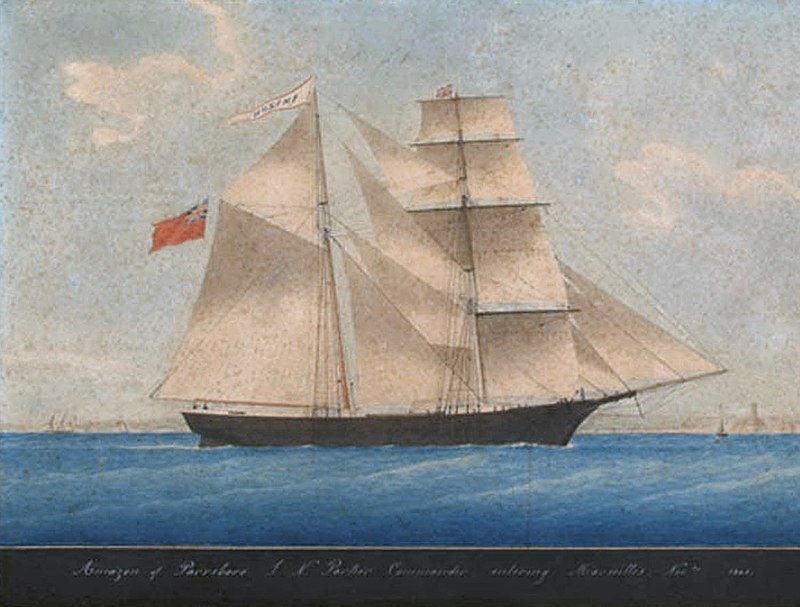
The Mary Celeste (or Marie Céleste as it is fictionally referred to by Sir Arthur Conan Doyle and others after him) was a brigantine merchant ship famous for having been discovered on 4 December 1872 in the Atlantic Ocean unmanned and apparently abandoned, despite the fact that the weather was fine and her crew had been experienced and able seamen. The Mary Celeste was in seaworthy condition and still under sail heading toward the Strait of Gibraltar. She had been at sea for a month and had over six months' worth of food and water on board. Her cargo was virtually untouched and the personal belongings of passengers and crew were still in place, including valuables. The crew was never seen or heard from again. Their disappearance is often cited as the greatest maritime mystery of all time.
The fate of her crew has been the subject of much speculation. Theories range from alcoholic fumes, to underwater earthquakes, to waterspouts, to paranormal explanations involving extraterrestrial life, unidentified flying objects (UFOs), sea monsters, and the phenomenon of the Bermuda Triangle, although the Mary Celeste is not known to have sailed through the Bermuda Triangle area. The Mary Celeste is often described as the archetypal ghost ship, since she was discovered derelict without any apparent explanation, and her name has become a synonym for similar occurrences.


Freak Waves

Extremely large waves can appear seemingly at random, even in calm seas. One such rogue wave caused the Ocean Ranger, then the world's largest offshore platform, to capsize in 1982. There is, however, no particular reason to believe rogue waves are more common in the Bermuda region, and this explanation cannot account for the loss of airplanes.
Research has shown that freak waves up to 30 m (100 feet) tall, capable of sinking the largest ships within moments, can and do happen. Although these are very rare, in some areas ocean currents mean they happen more often than the norm. Such waves have now been hypothesized as a cause for many unexplained shipping losses over the years.
The book was a best seller, and many interested readers offered theories to explain the nature of the disappearances. The list includes natural storms, transportation by extraterrestrial technology, high-traffic volumes (and correspondingly high accident rates), a "temporal hole," the lost Atlantis empire from the bottom of the ocean, and other natural and supernatural causes.

Glowing Water


Aerial photos taken in 2005 show the phenomenon of glowing water. Whatever causes this phosphorescence to vent up from the Bahama Bank bottoms, if that is its cause, remains a mystery.
The Triangle's location in the Caribbean makes it subject to unpredictable weather patterns. This takes us to Earth changes and the excalation of intense hurricanes in 2005 with more to come in the years ahead.
These weather extremes prey on inexperienced navigators and smaller boats and planes. Water spouts, sudden electrical and thunder storms, and the like, can cause havoc in the area. The Gulf Stream can also be brutal in that region and perhaps has swept away evidence of natural disasters.

Twitter Delicious Facebook Digg Stumbleupon Favorites More